Neuron
Bob wants the heater to work harder when his room is cold and rest when it is warm. A box sees the temperature and returns a power setting. What must happen inside?
AFTER THIS LESSON By the end, you can trace one room temperature through a neuron, explain what its two adjustable numbers do, and tell which part simply prevents negative heater power.
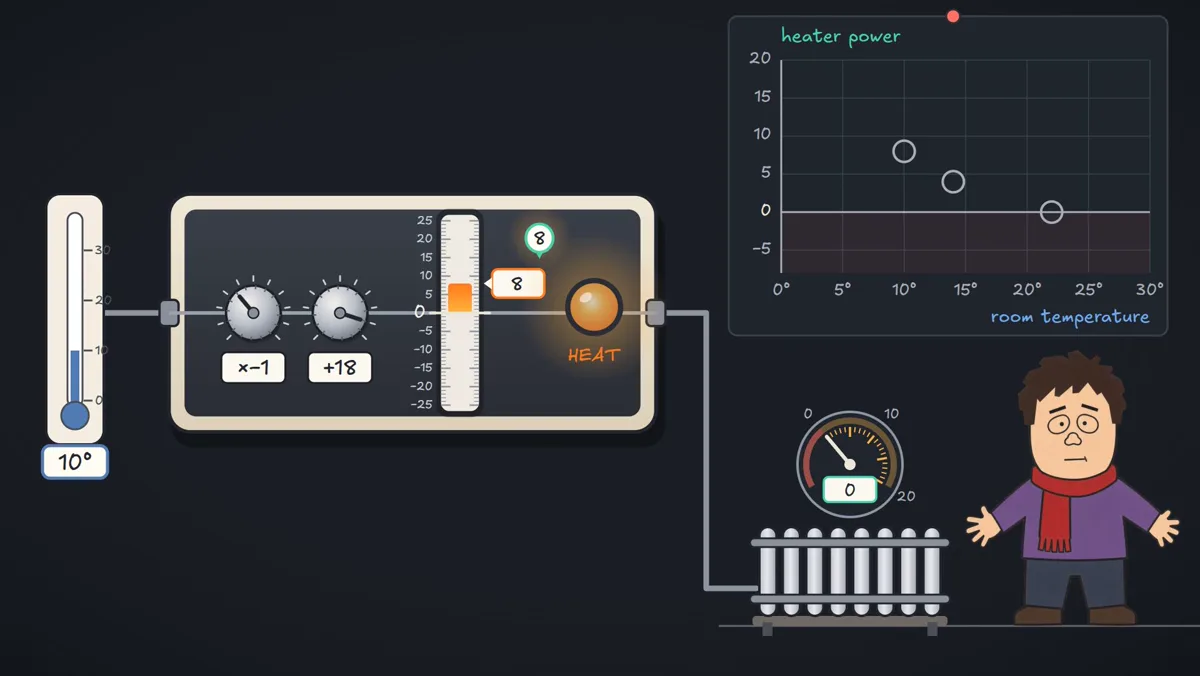
Heater rule
At 10°C, Bob wants a lot of heat. Near a comfortable 18°C, he wants none. A thermostat could use a hand-written rule, but we will build the smallest kind of rule a network can use: give it one number, let it do arithmetic, and read one answer. Here the input is room temperature; the output is a heater power setting, not a yes-or-no verdict.
First multiply the temperature by −1. That makes colder readings count more strongly: 10 becomes −10, while 22 becomes −22. Then add 18. At 10°C the result is 8; at 22°C it is −4. Since the heater cannot supply negative power, a fixed gate replaces any negative result with zero. This multiply–add–gate box is one artificial neuron.
Three rooms, the same rule
−1 × 10 + 18 = 88 power−1 × 18 + 18 = 00 power−1 × 22 + 18 = −40 after the gateParameters
The multiplier is called a weight. Its negative sign makes the answer fall as temperature rises; its size controls how steeply. The added 18 is a bias. Moving it shifts the point where heating stops. The gate is a fixed operation called ReLU: it passes positive values through and turns negative ones into zero. The graph is a ramp because that gate makes a corner at zero.
We chose −1 and 18 ourselves, so this box has not learned anything yet. Later, examples of what Bob wanted will tell the box how to change its weight and bias. For now, use the controls to see the job of each part separately.
Try the rule
Change the room temperature. Then remove a part and see which job is lost.
The room is cold, so the heater supplies power 8.
Predict before you reveal: at 22°C, what happens if you remove the bend?
The arithmetic still gives −4, but without the final gate the box would report −4 power. That is why the bend is part of this particular heater rule. It does not choose the slope or the stopping point; the weight and bias do.
WHAT CHANGED? The same temperature can give a different answer when a part of the rule changes.
Key concepts
- Artificial neuron
- A small input-to-output calculation: multiply an input by a weight, add a bias, then apply a fixed output rule. Bob’s example turns temperature into heater power.
- Weight
- An adjustable multiplier on an input. Bob’s −1 makes heater power fall as temperature rises.
- Bias
- An adjustable number added after the multiplication. The 18 shifts where Bob’s heater reaches zero.
- ReLU
- A fixed gate that outputs zero for a negative result and otherwise passes the result through. It makes the corner in the heater ramp.
The compact version, once you have seen it
power = max(0, weight × temperature + bias)
For Bob: max(0, −1 × temperature + 18). The fixed max(0, …) bend is called ReLU.